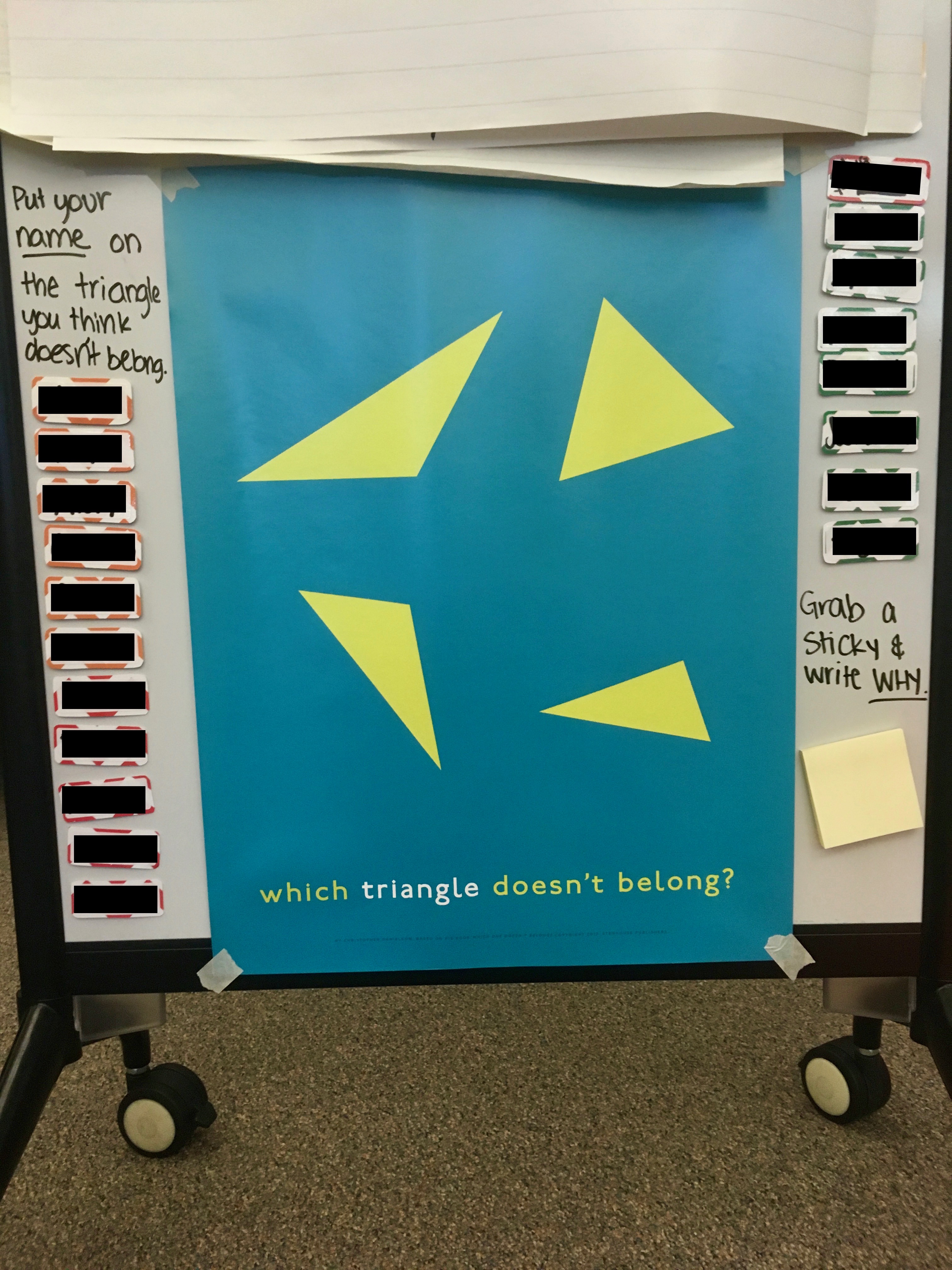
One of my favorite activities I did regularly with my 2nd graders in the past couple months was inspired by Christopher Danielson’s “Which One Doesn’t Belong?” posters.
The posters came in a set of 8 – a perfect amount for us to explore one per remaining week of school. I found some unused magnetic name tags and decided on this set up.
I had no idea what was going to happen – I gave no verbal directions (only vaguely pointing out we had something “new” in our classroom). It took a couple days, but students did start to engage.
Students’ thinking about the equilateral triangle not being “stretched” shows that they’re beginning to think about the relative size of angles.
Each week, I would put up a new poster on Monday and we would have a whole-class discussion about our ideas on Friday.
As we continued with this routine week after week, students’ reasoning became more sophisticated and their engagement increased as well – students would sneakily move their name to a shape during circle times and transitions. They would congregate around the poster, asking about and pushing back on each other’s choices.
Nobody chose the blue square because it was the most “regular”. What might make a shape “regular”? Do some properties of shapes matter more than others?
Here are some of my favorite noticings and conversations we had.
The top right hexagon can be turned into a drawing of a cube by drawing three lines. (Do you see it?)
The other three hexagons can be “squished” a bit to all look the same. (What does this tell us about angles?)
The top left shape (in the poster on the right) could be straightened out into a very long, skinny rectangle.
What is a shape? Are letters shapes? Is everything a shape? Do all shapes have names?
What is a polygon? Can we come up with a definition from this poster (below)? Could we explain it to a Kindergartener?
Ideas – a polygon might be: a shape with a lot of sides, a shape with at least 4 sides, a shape with any number of sides that are “line segments”.
The top left doesn’t belong “because it is a square and I don’t know what a polygon is but I know it is not a square!”
Now for some questions moving forward…
How might you use these posters in your classroom the whole year? With younger kids? Older?
How might you support students to create their own WODB images, perhaps moving beyond just shapes?
Also known as: My Absolute Favorite Activity to Do with Children
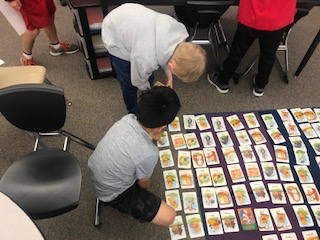
What kinds of pattern and structure do you see in this picture of students counting?
“Ms. Janaki! Come look at how we counted! We put thirty on each plate and now we’re putting five more on each plate until we run out.” I don’t think I’ve ever seen students as excited in math as when we were counting collections. But beyond just excitement – the value of children counting has been well-documented.
There is appeal in the simplicity of the launch (“go count!”), the flexibility and repeatability of the task (“count in any way that makes sense to you”; “count it in a different way”), and also the complexity of the outcome and what it can teach us about how children think and reason mathematically. Not to mention strengthening the connection between concrete, physical quantities and more abstract ideas of number.
A student demonstrating two groups five make ten and using that idea to count.
At first, most kids in my class immediately started grouping by fives. I had given them collections I knew were between 200 and 500 objects, and this turned into a time-consuming and arduous task. Many did not finish counting all their objects the first time around. Part of the beauty of this task is that is an exercise in patience for the teacher, as it allows them to actually see their students’ thinking, instead of immediately pushing for accuracy and efficiency.
A student who did not finish counting but discovered that making a “rainbow” of popsicle sticks with 5 sticks of each color could allow you to count by 30s.
Students also had to navigate the social situation of counting with a partner. Some pairs of decided to count separately and combine their totals at the end – others agreed on a mutual counting strategy and played different roles in keeping track of their collection.
Counting collections authentically introduces new mathematical ideas to students. The kids from the quote at the beginning are discovering partitive division. Others were using measurement division – if we put 50 objects on each plate, how many plates will we need?
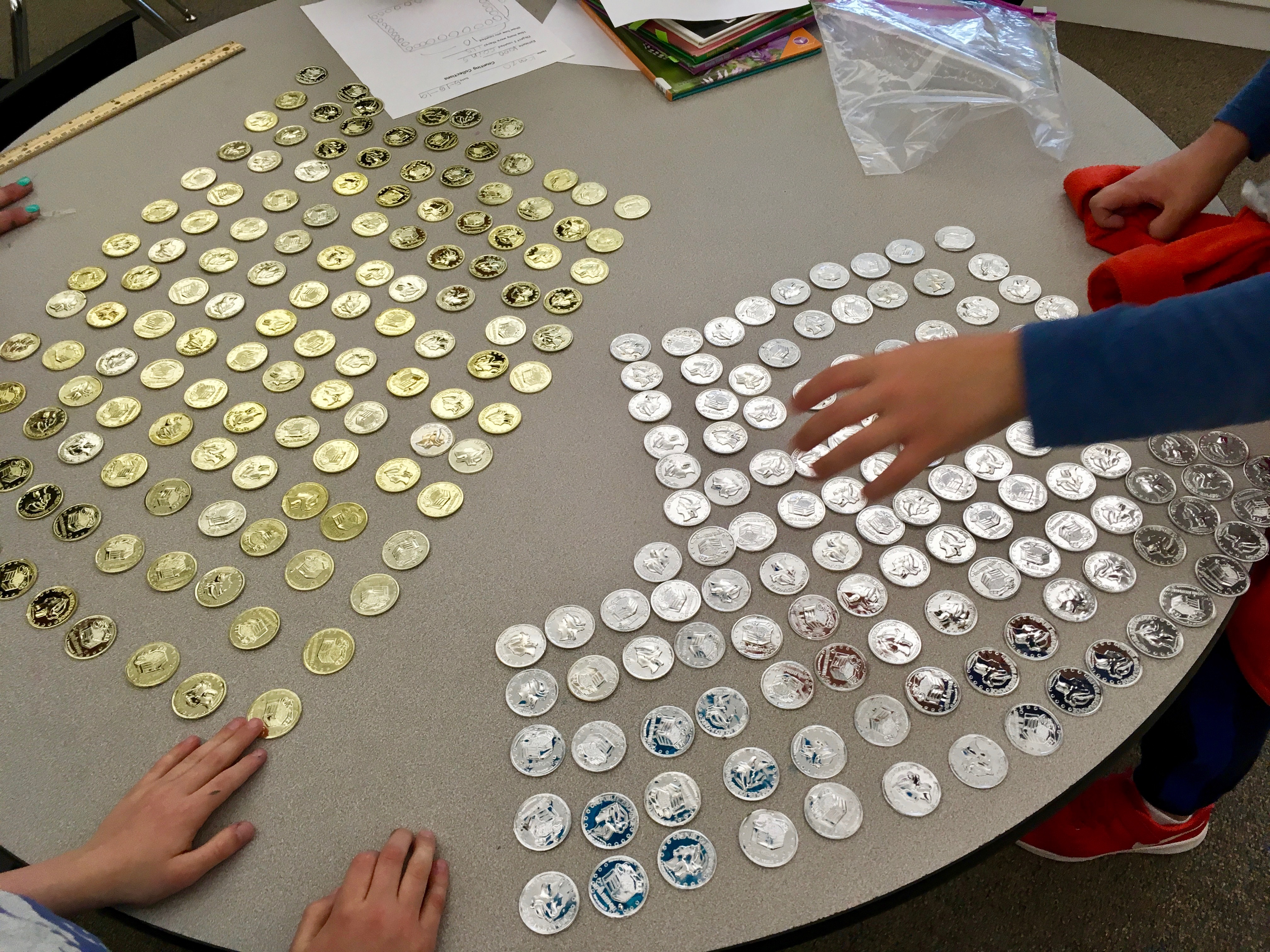
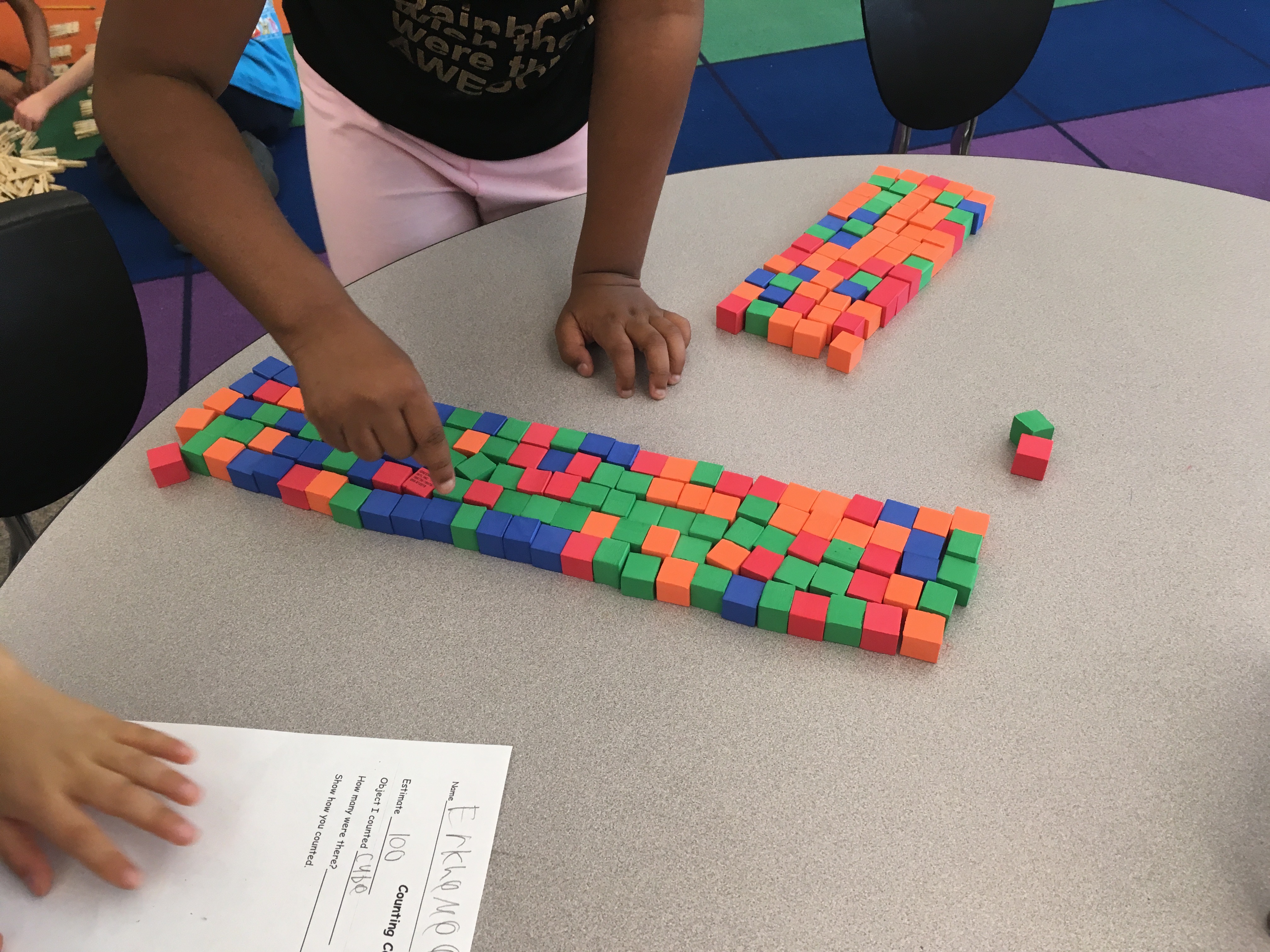
Many also began utilizing arrays – and arrays within arrays – to more quickly count their objects. Creating a seeing structure within objects and quantities is fundamental for students’ understanding of number.
But what about accuracy? What can errors tell us?
Students ambitiously create arrays to count – the first time they’ve ever done counting collections.
Students frequently made errors in counting, recording and/or calculating. It was extremely tempting as a teacher to want to see if they got the “right” number, or jump in and point out mistakes. It took a lot of practice (and will continue to take more!) to be able to know what questions to ask to prompt students to check for accuracy themselves instead of “fixing” it for them.
This student made a slight calculation error – can you figure out why?
There is also a lot of value in seeing their mistakes. A student whose count is off because as they count by tens, they write “90, 100, 101, 110” is facing a different challenge than one who’s having trouble keeping track of what they’re counting or one whose groups are not equal. Errors show how to best support each student moving forward.
Extending the task – now what?
One day, as students were counting collections, a significant number of pairs had finished counting and recording quickly while others were still diligently working. I didn’t have enough collections for students to grab a different one, so I had to think quickly – I looked around the classroom to try and find some things students could count. Here’s what I came up with.
Count the books in the classroom library without taking them out of their bins.
Count how many crayons everyone has – you can open boxes, but don’t take them out.
Count how many dot stickers are on these sticker sheets without removing them. (Bonus – some were torn!)
Count how many keys are on all the keyboards in the classroom without moving the computers (please don’t move the computers!)
This was very successful, so the next time I had students do a “choose your own adventure” and count whatever they could find in the classroom and record how they counted.
Students were able to use the way objects that were too cumbersome to move were organized to help figure out how many there were.
Some lingering questions and things of interest
Seeing students negotiate how to count (or whether to count) parts of objects, such as the ripped stickers or broken clothespins was very interesting.
I kind of want to rip/break objects in each of the collections on purpose, just to see what they’ll do with it.
I wonder what students would do with objects that are the same type but have differing sizes? I’m picturing a giant tub of googly eyes we had in our classroom that were all different sizes.
I’m still learning how to navigate the social issues that arise between partners (or what to do when the “I’m going to start throwing my objects and laughing” starts). Anybody have tips on this?







 Thinking With Children